

The Talent Gap in India’s Manufacturing & Engineering Sector — and How Companies Can Bridge It
Introduction: The Growth Story Meets a Talent Challenge
India’s manufacturing and engineering sectors are standing at an inflection point. With the government’s Make in India 2.0, the rise of Industry 4.0, and a renewed focus on domestic and export-led manufacturing, the industry outlook appears promising.
However, one critical constraint continues to slow this momentum — the availability of skilled and future-ready talent.
From automotive to precision engineering, industries across India are experiencing a paradox: new opportunities are emerging faster than the workforce can adapt. The question isn’t whether India can manufacture at scale — it’s whether it can build and sustain the skilled teams to power that scale.
1. Understanding the Depth of the Talent Gap
The issue isn’t merely about unfilled vacancies — it’s about the right skills being unavailable at the right time.
A 2024 Skill Council study revealed that over 65% of manufacturing employers struggle to find mid to senior-level professionals equipped with modern technical competencies such as automation integration, mechatronics, or digital twin modeling.
Key factors contributing to this include:
- Technological shifts outpacing workforce capabilities: The move toward smart factories and connected supply chains demands multidisciplinary expertise, blending traditional mechanical knowledge with digital fluency.
- Aging workforce in core manufacturing roles: Many experienced shop-floor professionals are approaching retirement without adequate succession pipelines.
- Educational misalignment: Curriculums at technical institutes often lag behind the rapid evolution of production technologies and sustainability practices.
- Rising competition from emerging sectors: Renewable energy, EV, and semiconductor industries are pulling talent from traditional manufacturing, creating further vacuum.
2. The Emerging Talent Divide
India’s industrial ecosystem today can be viewed in two parallel streams:
- Digitally progressive manufacturers rapidly adopting Industry 4.0 tools, analytics, and automation.
- Traditional manufacturers still dependent on legacy systems and manual processes.
The talent divide between these groups is widening. Organizations at the forefront of digital transformation face acute shortages of engineers skilled in areas like AI-driven quality control, industrial IoT, and predictive maintenance.
Meanwhile, conventional manufacturers struggle to attract younger professionals who view such workplaces as outdated or lacking growth potential.
This divide highlights a structural problem — the skills of the workforce are evolving slower than the needs of the industry.


3. Why Traditional Recruitment Models Are Falling Short
For years, recruitment in the manufacturing and engineering sectors has been transactional — focused on filling open roles rather than building capabilities. But as technology becomes central to every operation, organizations need talent partners who understand both domain depth and digital fluency.
Conventional hiring approaches fail because:
- Job descriptions are outdated: Many roles are still defined around legacy requirements rather than future responsibilities.
- Talent sourcing is reactive: Recruiters search when a vacancy arises instead of maintaining a proactive talent pipeline.
- Candidate engagement is weak: Engineers now seek purpose, technology exposure, and career progression, not just compensation.
The result? Longer hiring cycles, mismatched candidates, and higher attrition.
4. The Three Pillars of Bridging the Talent Gap
To bridge the widening talent divide, organizations must go beyond reactive recruitment. They need a Talent Transformation approach that integrates hiring, learning, and long-term retention.
Pillar 1: Strategic Workforce Planning
Successful companies are rethinking their workforce strategy from short-term hiring to long-term capability building.
This involves mapping future skill requirements, identifying internal reskilling potential, and building partnerships with talent consulting firms that bring data-backed insights and real-time market intelligence.
Pillar 2: Hiring for Learnability, Not Just Skills
In a rapidly evolving industrial landscape, adaptability has become the most valuable competency.
Recruiters and hiring managers should assess candidates on problem-solving, digital curiosity, and cross-disciplinary learning potential — not just years of experience or tool familiarity.
Those who can learn fast can transform faster.
Pillar 3: Integrating Training as a Core HR Function
The line between recruitment and training is blurring. The most forward-looking firms invest in upskilling immediately after hiring, ensuring new employees are productive within weeks.
Customized training programs — particularly in areas like Lean automation, digital manufacturing, and data-driven maintenance — not only accelerate performance but also boost retention and morale.
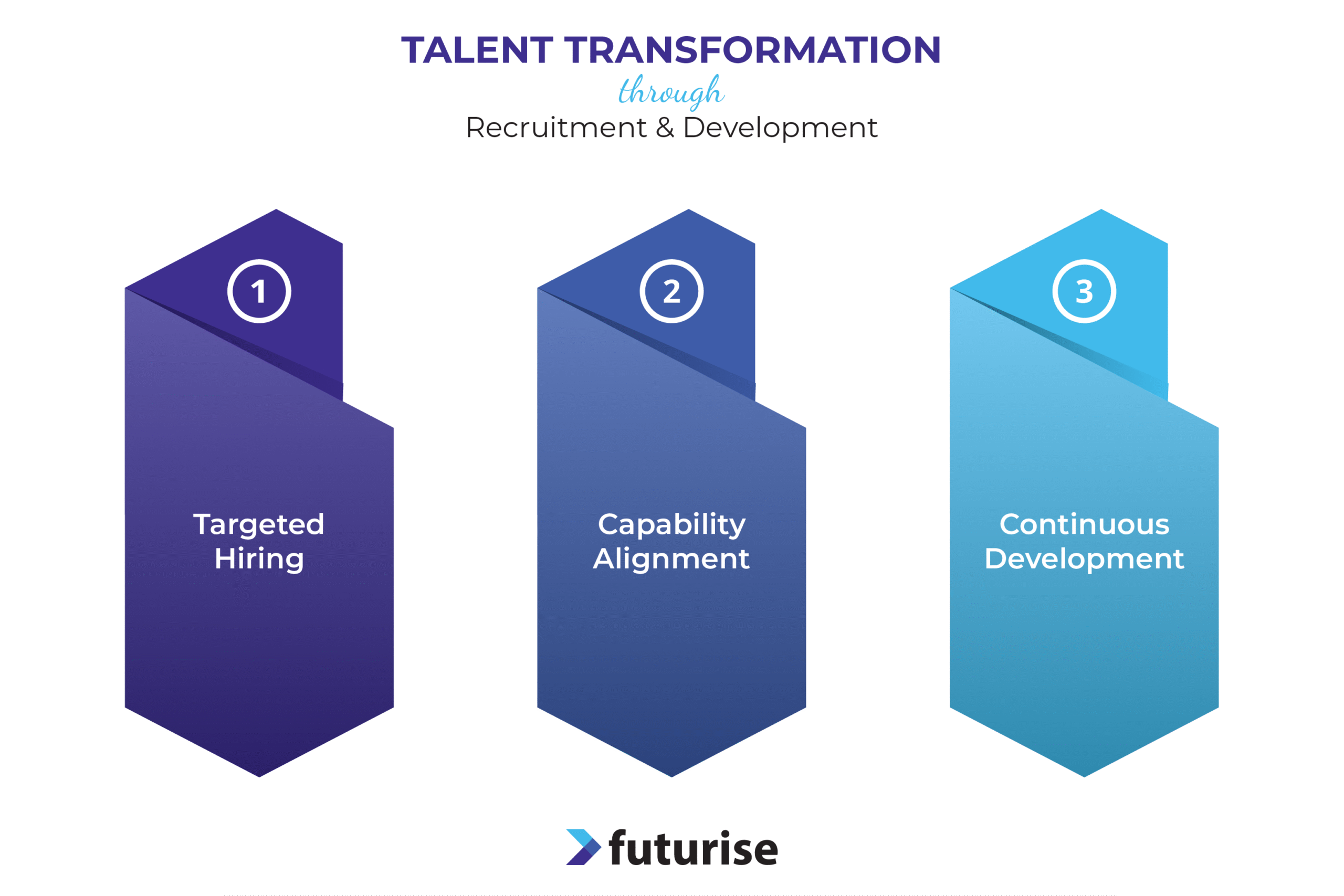
5. How Futurise Approaches Talent Transformation
At Futurise, we view recruitment as only one part of the talent equation. The other — and often more powerful — part is development.
Our approach combines:
- Targeted hiring: Identifying professionals who align with both technical and cultural DNA of the organization.
- Capability alignment: Bridging gaps between market-ready skills and organizational expectations through structured onboarding and training.
- Continuous development: Designing soft-skills and leadership programs that enhance collaboration, communication, and problem-solving — crucial in today’s cross-functional manufacturing environments.
This model ensures organizations don’t just fill roles; they build resilient, future-ready teams.
6. The Payoff: Business Impact Beyond Hiring
Bridging the talent gap is not just an HR goal — it’s a business imperative.
Companies that align their people strategy with their growth strategy experience measurable gains:
- 40% faster project execution through reduced hiring lag.
- 25–30% improvement in retention when learning pathways are integrated from day one.
- Higher innovation output, as multidisciplinary teams bring fresh perspectives and digital fluency.
Most importantly, when employees see investment in their growth, they become ambassadors of the brand — attracting more quality talent organically.
Conclusion: The Future Belongs to Talent-Centric Manufacturers
India’s manufacturing resurgence will be defined not just by capital or capacity, but by capability.
The organizations that thrive will be those that treat talent not as a cost center, but as a competitive advantage — and invest in building it strategically.
At Futurise, our mission is simple: to help businesses bridge today’s talent gaps while preparing for tomorrow’s opportunities. Because when people evolve, industries transform.
👉 Ready to future-proof your workforce?
Let’s start a conversation about how we can help you attract, train, and retain the talent that drives transformation.