

Why Soft Skills Are the Real Competitive Edge in a Tech-Driven World
Introduction: The Paradox of the Modern Workforce
The modern workplace is undergoing a quiet revolution.
Artificial Intelligence, automation, and digital transformation are reshaping industries, redefining roles, and rewriting the skills employers need. Yet, amid this technological acceleration, one truth stands out clearly — it’s the human skills that set organizations apart.
Across sectors, leaders are realizing that while technical proficiency gets the job done, it’s soft skills that get the job done right.
1. The Shift from “Hard Skills First” to “Human Skills Always”
For decades, recruitment strategies — especially in technology and engineering — were centered around technical mastery. Hiring decisions were driven by certifications, coding proficiency, and domain knowledge.
But the post-pandemic workplace, marked by hybrid collaboration and cross-functional problem-solving, has changed this equation dramatically.
A 2024 Deloitte study found that 92% of talent leaders now consider soft skills equally or more important than technical skills in determining long-term success.
Soft skills — communication, adaptability, emotional intelligence, teamwork, and leadership — are not “nice to have” anymore. They are non-negotiable for individual and organizational effectiveness.
2. The New Reality: Technology Without Soft Skills Fails
The most advanced technology is only as effective as the people who build, implement, and use it.
Consider these examples:
- A brilliant developer may write perfect code, but without collaboration, integration projects can stall.
- A high-performing engineer may solve complex problems, but without communication, those solutions never scale.
- A technically sound manager may design a great process, but without empathy, the team burns out before delivering results.
Soft skills act as the connective tissue of modern organizations — binding strategy, technology, and people together into cohesive performance.


3. The Business Case for Soft Skills
a. Higher Retention and Engagement
Employees who feel heard, valued, and understood are far less likely to leave.
Soft-skilled leaders foster cultures of inclusion and psychological safety — two of the strongest predictors of engagement and retention.
b. Improved Cross-Functional Collaboration
As organizations evolve into matrix structures, success depends on the ability to collaborate across functions, geographies, and digital platforms.
Teams with strong communication and interpersonal skills consistently outperform others in project delivery, innovation, and customer satisfaction.
c. Better Client Relationships
In client-facing industries — IT services, consulting, manufacturing, or startups — success depends as much on relationships as on results.
Soft skills ensure client alignment, expectation management, and trust — the foundation for long-term partnerships.
d. Leadership Agility
The most effective leaders today are those who can balance strategic thinking with emotional intelligence.
According to Korn Ferry’s 2023 Leadership Study, leaders who scored high on empathy and adaptability drove 20–25% higher business performance across diverse industries.
4. Why the Soft Skills Gap Is Growing
Despite their importance, the global workforce faces an alarming shortage of strong interpersonal capabilities.
Key reasons include:
- Overemphasis on technical training: Education systems reward technical proficiency over communication and collaboration.
- Limited organizational focus: Many L&D programs prioritize compliance or role-specific skills rather than behavioral competencies.
- Hybrid working models: Reduced in-person interaction has eroded informal learning and interpersonal confidence.
- AI-driven isolation: Increased automation has shifted focus away from human-led problem-solving and creative thinking.
The result? Teams that are technically competent but culturally fragmented, efficient but disengaged, and innovative but disconnected.
5. How Organizations Can Close the Soft Skills Gap
Forward-thinking organizations are embedding soft skills as a strategic pillar of workforce transformation. Here’s how:
Step 1: Redefine Hiring Metrics
Integrate behavioral indicators into the hiring process.
Assess candidates not only on what they know, but on how they think, respond, and interact.
Behavioral interviews, situational role plays, and psychometric assessments can reveal adaptability, empathy, and resilience.
Step 2: Train for Behaviors, Not Just Skills
Training programs must evolve from lecture-based models to experiential learning — simulations, group exercises, and scenario-based interventions.
At Futurise, our soft skills programs emphasize practical applicability, enabling employees to communicate effectively, lead teams confidently, and collaborate across cultural and functional divides.
Step 3: Build a Coaching Culture
Managers must be trained not just to manage but to coach.
Continuous feedback, mentoring, and recognition nurture a culture where soft skills are practiced daily — not once a quarter.
Step 4: Measure What Matters
Organizations that treat soft skills as intangible find it hard to sustain progress.
Tracking metrics such as engagement scores, collaboration feedback, and communication effectiveness can quantify behavioral improvement and tie it to business results.
6. The Futurise Approach to Building Human-Centric Teams
At Futurise, we believe that the future of work belongs to organizations that balance technical excellence with human intelligence.
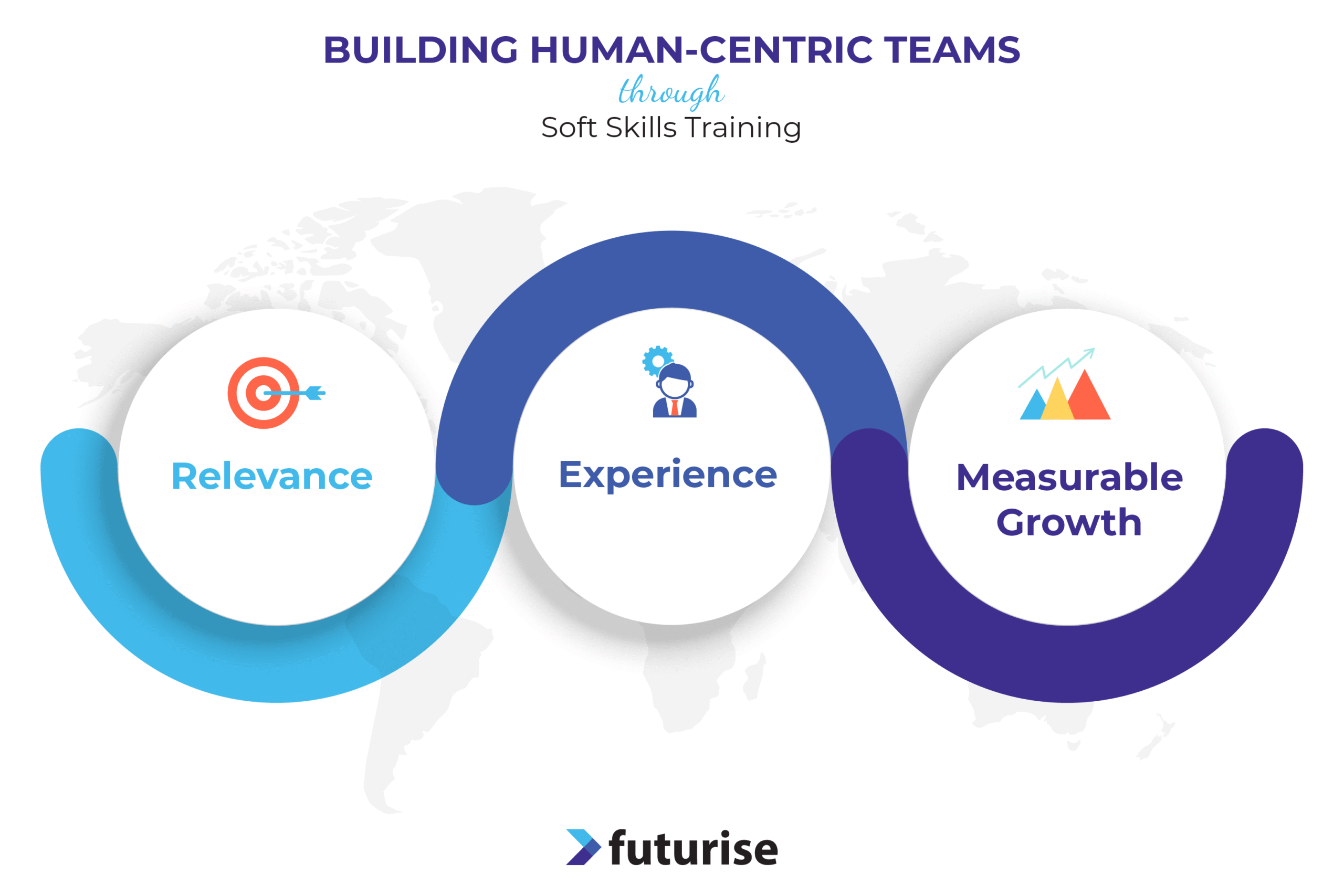
Our soft skills training programs are designed with three core objectives:
- Relevance: Content tailored to your industry context — from manufacturing floor leadership to virtual client delivery in IT.
- Experience: Highly interactive formats that ensure real-world practice, not passive learning.
- Measurable Growth: Clear before-and-after assessment frameworks to track improvement in communication, teamwork, and leadership impact.
Through these programs, employees don’t just learn — they evolve. They begin to influence outcomes, drive change, and build stronger workplace connections.
7. Beyond Skills: Building a Culture of Connection
The next decade will belong to organizations that lead with empathy and adaptability.
While technology can automate processes, it can’t replicate curiosity, compassion, or creativity — the very traits that drive innovation and trust.
By embedding soft skills into hiring, training, and leadership, businesses not only prepare their workforce for change — they future-proof their culture.
Conclusion: The Human Edge in the Age of AI
In the race toward digital transformation, many companies are optimizing machines — but the real opportunity lies in optimizing people.
Soft skills are not an alternative to technology; they are the multiplier that makes technology work better.
Organizations that recognize this truth will lead the next phase of business transformation — one powered not just by algorithms, but by authenticity.
👉 Empower your teams with the skills that truly matter.
Explore how Futurise can help your organization strengthen communication, collaboration, and leadership for lasting impact.